

Invasive Plants of the Illinois River Watershed
Our region has several invasive species, some of which outcompete native species of plants and some which have largely been able to integrate with our region’s vegetation and ecology. We encourage the public to be aware of the most important species which require active monitoring and a regionally coordinated approach to management.
Wintercreeper (Euonymus fortunei)
Our friends at the Watershed Conservation Resource Center (WCRC) have crafted a handy guide to invasive plants prevalent in Northwest Arkansas, and applicable to much of Northeast Oklahoma as well.

The City of Fayetteville website offers resources on Invasive Plant Species, along with native alternatives for landscaping.

Find the tools you need to get started removing invasives at this site provided by Ecological Landscape Alliance.
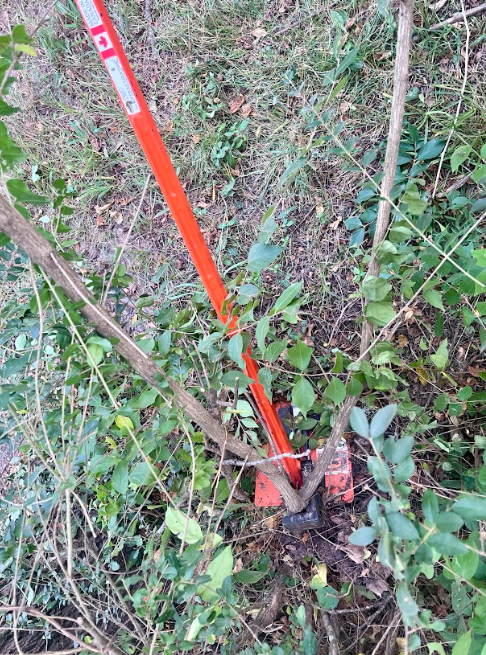
This piece of equipment is called a “Pullerbear” and makes removing shrubs like honeysuckle an easy task!
Invasive Plant Species
in the Illinois River Watershed
(Information adapted from the WCRC Invasive Species Field Management Guide.)
Invasive Trees


Tree of Heaven
Ailanthus altissima
Some say Tree of heaven smells like rancid peanut butter!
-
Introduced ornamental c.1784 from Europe, orginated in China. Highly invasive.
-
Present in most lower 48 states, listed as noxious or banned in some areas. Well established in Northwest Arkansas. Can be found along forest edges, disturbed and undisturbed sites. Large groves have been reported along HWY 71 in the Ozark National Forest.
-
Rapidly growing tree that forms dense thickets and suckers from roots. Prolific seeder spread by wind. Leaf litter and roots also produce allelopaths or toxins that prevent germination of other plants.
-
Tall deciduous tree with shallow roots. Mature trees often lack lower branches. Alternate, pinnately compound green leaves with reddish stems near new growth. Circular glands under leaf base. Brown to tan bark. Wing-shaped seed clusters resemble maple fruits. Unpleasant odor when crushed. Resembles hickory, walnut, sumac.
-
Remove entire seedlings; basal bark method or frill application during mid-to-late summer for more mature plants. Do not use cut-stump as it will encourage suckering.


Certain states have banned the sale of Bradford pears.
Callery (Bradford) Pear
Pyrus calleryana
-
Invasive ornamental introduced from Asia. One of the most common and troublesome invasive trees escaped from rootstock.
-
Widely present in southern US. Invades forest edges, hillsides, fencerows, open fields, and rights-of-way disturbed areas.
-
Displaces native vegetation, prolific seeder dispersed by birds. Forms thickets and can sprout from roots. Prone to splitting in storms.
-
Deciduous, medium-sized tree, abundant white flowers blossom in early spring before most natives. Alternate “fruit” leaves oval turning red or orange in fall. Small pears in clusters.
-
Cut to stump in fall and apply 50% glyphosate immediately after cutting. Repeat seasonally.


A mimosa tree’s leaflets quickly turn inward when touched or shaken.
Mimosa (Silk Tree)
Albizia julibrissin
-
Invasive ornamental introduced from Asia c.1745.
-
Widely present in southern US and west. Commonly seen along streams, trails, and forest edges, rights-of-way.
-
An adaptable tree that can establish dry or moist sites. Forms dense stands. Negatively displaces natives and is a poor food source for wildlife. Seeds can remain viable in seedbank for many years.
-
Small to medium deciduous legume with showy pink flowers and large, flat, seed pods turning brown in fall. Alternate bi-pinnately-compound green leaves resemble locust trees.
-
Cut stump and apply herbicide.
Invasive Shrubs


Bush Honeysuckle produces bright red berries in late summer.
Bush Honeysuckle
Lonicera maackii
-
Invasive ornamental hedge introduced from China.
-
Widely present in southern US. Invades forest understory, fencerows, along streams, and rights-of-way.
-
Aggressive, shade-tolerant shrub that forms dense thickets, often creating monoculture preventing forest regeneration, especially in urban forest near where plants escaped or were planted. Poor wildlife food source. May contribute to increased tick populations.
-
Multi-stemmed upright shrub, bark light brown with striations, sometimes hollow. Opposite leaves ovate to oblong. Distinct sweet smelling white and yellow flowers in spring and summer produce glossy red berries when ripe.
-
Remove entire plant. Cut to stump in fall and apply 50% glyphosate immediately after cutting. Repeat seasonally until suckers are no longer present.
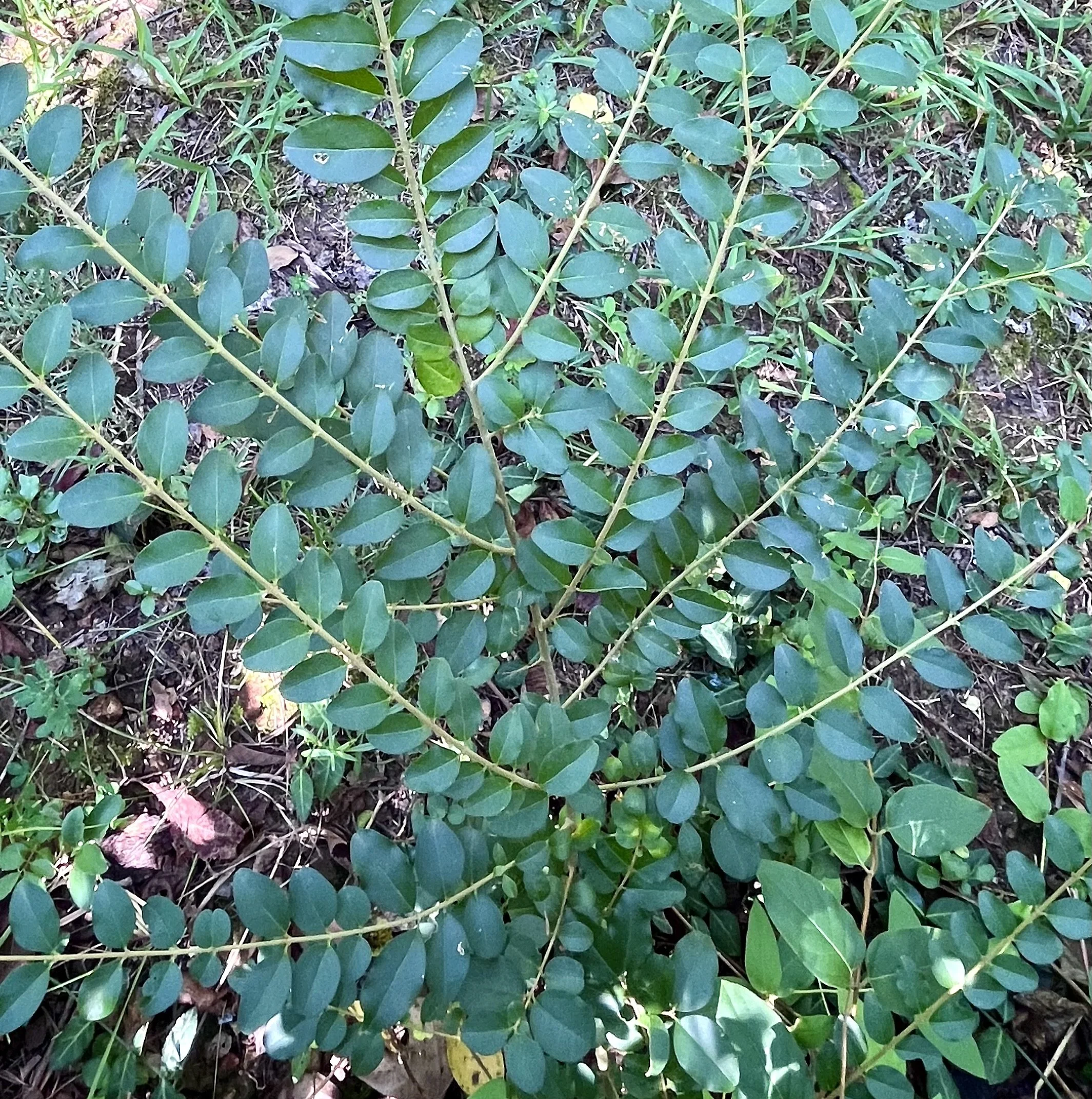

Honey made with Chinese Privet flowers has an off flavor due to the chemical methylamine the flower produces.
Chinese Privet
Ligustrum sinense
-
Invasive ornamental hedge introduced from China and Europe c.1852. One of the most common and troublesome invasive plants.
-
Widely present in southern US. Invades forest understory, fencerows, along streams, and rights-of-way.
-
Aggressive, shade-tolerant shrub that forms dense thickets, often creating monoculture preventing forest regeneration, especially in urban forest near where plants escaped or were planted. Poor wildlife food source.
-
Multi-stemmed shrub of the Olive family with opposite, glossy, oval, green leaves. Fragrant white flowers April to June produce abundant, green berry-like drupes turning dark purple. Propagates through seed spread by animals and is a prolific suckering plant.
-
Remove entire plant if possible. Cut to stump in fall and apply 50% glyphosate immediately after cutting. Repeat seasonally.


An average multiflora plant is said to produce a million seeds a year and they remain viable for 20 years or more.
Multiflora Rose
Rosa multiflora
-
Invasive rose introduced from Japan in 1700s as ornamental or living fence.
-
Prominent in most US states except mountainous western states. Invades forest understory, pasture, fencerows, woodland stream terraces, and rights-of-way.
-
Adaptive plant that displaces native vegetation by forming monoculture of dense thickets.
-
Multi-stemmed, finely-thorned shrub reaching 12 to 15 feet in height. Ovate or oblong leaves, pinnately compound, up to 7 leaves per leaflet. White flowers bloom in clusters in spring. Fruit are small red hips frequently consumed and spread by birds. Very thorny and difficult to remove.
-
Remove entire plant if possible. Cut to stump in fall and apply 50% glyphosate immediately after cutting. Repeat seasonally.
Invasive Vines


Wintercreeper can grow as a vine on a tree or as ground cover.
Winter Creeper
Euonymus fortunei
-
Introduced from Asia as ornamental ground cover in early 1900s. Resembles periwinkle (Vinca). Highly invasive in Northwest Arkansas’ urban forests, along trails, streams, forest edges and understories.
-
Eastern and southern US.
-
Adaptable, aggressive, vine that forms dense groundcover or climbs structures including trees, which may be choked. The vine will completely cover large areas of forest floor and out-compete native plants. Fruit spread by birds. Weight can eventually topple trees and fences.
-
Evergreen woody vine forming numerous clinging stems. Opposite, oval, glossy green leaves with prominent veins. Inconspicuous flowers produce small red capsules at the end of y-shaped stems that split, exposing seeds.
-
Cut stump and apply appropriate herbicide. Late winter treatment will avoid non-target damage. Repeated treatments likely. Hand pull small infestations.
Caution: wintercreeper attached to a tree may transfer herbicide to the tree.


Japanese honeysuckle vines can grow 80-120 ft tall if they have something to climb up.
Japanese Honeysuckle
Lonicera japonica
-
Invasive, even prohibited or banned in some northern states. Reportedly introduced as ornamental in early 1800s.
-
Invasive across Southeast US. Invades forest edges, floors, glades, wetlands, and rights-of-way.
-
Shades and chokes native vegetation. Can form dense groundcover or climb and choke other vegetation up especially where light penetrates canopy.
-
Semi-evergreen climbing vine, leaves opposite, oval or oblong. Young leaves may show lobed margins. Showy white and yellow flowers produce sweet smell. Small berries start green and darken into fall.
-
Mechanical removal must be accompanied by chemical stump treatment. Foliar spray effective when other vegetation is dormant. Burning could significantly reduce populations.


Some say their flowers smell like a combination of baby powder, honey, sugar, vanilla, and jasmine.
Sweet Autumn Virgin’s-Bower
Clematis terniflora
-
Established invasive ornamental often referred to as Sweet Autumn Clematis.
-
US southeast. Appears along forest edges, roadsides, rights-of-way, streams, and trails.
-
Displaces native vegetation. Local extension reports that some people may experience skin and eye irritation if mowed over.
-
Semi-evergreen climbing vine, opposite, compound leaves, elongated, heart-shaped. White, fragrant, four-petaled flowers appear in the late summer through the fall. Seeds have wispy, feather-like hairs.
-
Cut stems low and treat with herbicide. Foliar sprays may be effective but care must be taken to avoid harming non-target plants.
Invasive Forbs


Water Hemlock is poisonous to both humans and livestock.
Poison Hemlock
Cicuta douglasii
-
Invasive ornamental introduced from Europe in 1800s. Also known as “Water Hemlock”
-
Widely present across US.
-
Poison hemlock can quickly overwhelm disturbed sites, including forest edges, rights-of-way, riparian areas, and upland stream terraces. Displaces native plants and can produce thousands of seeds per plant. All plant parts are extremely toxic if ingested, causing death. Skin contact can cause mild to severe irritation, and toxins may be absorbed through skin after prolonged contact. If ingested, call poison control at 1-800-222-1222.
-
Biennial herb reaching 8 feet in height, hollow, purple-mottled stems. Closely resembles other plants in parsley family such as wild carrot or Queen Anne’s Lace, which lacks purpling on stem. Small white flowers form in a cluster resembling an umbrella.
-
Foliar herbicides are effective, especially when plants are small in late winter or early spring. Contact your local extension office for herbicide ratings for brush control. Do not hand pull or touch this plant.


Perilla Mint leaves and oils are edible and have medicinal properties. They smell like licorice when crushed!
Perilla Mint
Perilla frutescens
-
Native to Asia, introduced ornamental invasive across US in 1800s.
-
Very adaptable, prominent in AR, LA, MO, OK, and TX.
-
Invades shady streambanks, pasture margins, roadsides, ditches, and forest edges outcompeting native plants. It is very toxic to cattle, especially if dried in hay. Avoidance by grazing animals also allows perilla mint to flourish and seed is easily spread by wind.
-
Annual herb 1 to 3 feet in height, squared-stemmed, opposite leaves up to 5 inches long by 4 inches wide. Also known as beefsteak plant, often displays purple coloring and is fragrant when crushed. Dried flower spikes persist through winter.
-
Control early when plants are small before flowering. Consistent mowing or hand pulling may control populations. Several foliar chemical options.


Perilla Mint leaves and oils are edible and have medicinal properties.
Queen Anne’s Lace
Daucus carota
-
Originated in Afghanistan and adjacent areas, then spread to Europe and finally introduced to North America as a medicinal herb.
-
Also known as wild carrot, Queen Anne’s Lace is present in the lower 48 states, including some areas where it is considered a noxious weed. It appears most frequently on roadsides, open fields, woodland edges, and any disturbed areas.
-
Queen Anne’s Lace is a fast growing early season plant that invades open areas where it competes with natives for space. It can grow to maturity quickly and put off seeds that are transported through wind.
-
Queen Anne’s Lace is a biennial that in its first year will grow several small hairy stems at the base that branch to many fernlike leaflets towards the top. The dark green color will be noticeable in winter, and will be one of the first species to start growing in the spring. The second year plants will grow stalks 2-4 feet in height and produce an umbrella cluster of flowers. The small 5-petaled white flowers will curl inward into the summer and turn a brown color.
-
Manual pulling or cutting of the plant will give natives a chance to outcompete it, but a chemical application of 2-4-D or triclopyr will easily control the plant.
Invasive Grasses


Japanese Stiltgrass prefers low-light conditions to grow in.
Japanese Stiltgrass
Microstegium vimineum
-
Native to Japan, China, and Asia, it was originally documented in Tennessee in 1919 and was believed to have been accidently transported through its use in packing material.
-
Currently present in 16 eastern states and favors moist, rich soils. Although it can be found in almost any environment, from full sun, to complete shade. It prefers the banks of rivers, floodplains, wetlands, and roadside ditches.
-
Since it grows well in most environments, it threatens understory vegetation by shading out valuable natives. It is very easily transported to newly disturbed areas where it will form a patch, then grows outward, displacing native vegetation.
-
Annual grass that grows 2-3 feet in height with small bamboo-like stalks. It produces leaves 3 inches in length that are lanced on the outer rim with a lighter colored rib running the length of the leaves. Its main seed dispersal mechanism is wind, but can also move with flood or runoff water.
-
Manual pulling or hand hoeing can be efficient for small, concentrated patches. Although larger areas are more easily controlled using Glyphosate herbicide.


Johnsongrass can grow up to 8 feet tall and blooms from June to November.
Johnsongrass
Sorghum halepense
-
Native to Africa, introduced in the 1800s as drought-tolerant forage.
-
Johnson grass has become widely naturalized throughout the south but is present nationwide in pasture, greenspace, and along fencerows and rights-of-way.
-
Forms dense colonies in fields and forest edges. Height allows this plant to outcompete native seedlings. Seeds and rhizomes remain viable in soil for many years. Nitrate accumulation under certain environmental conditions can cause toxicity in grazing animals.
-
Erect, perennial, tall, warm-weather grass with wide leaf blades up to 1.5 inches and prominent pale midvein. Flowers and seedheads form prominent panicle.
-
Can be sprayed in summer at height of 18 inches with Outrider. Rhizomes and colonies make pulling difficult. Repeated mowing and management can reduce populations.
Do you have problems with invasives on your property?
IRWP may be able to help through our Landowner Services provided in partnership with NRCS
